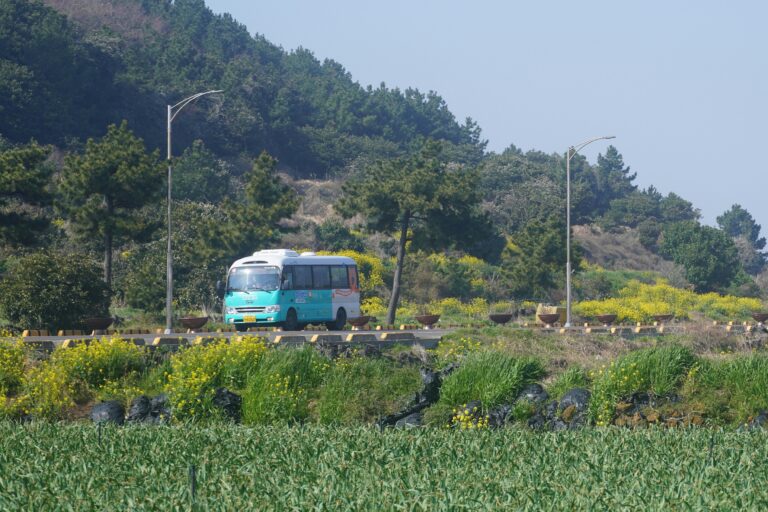
Getting Around Jeju — Quick Guide
How you get around Jeju depends mainly on how long you’re staying and where you plan to go. Below is a general guide:
- A few days – 2 weeks:
- covering many places → Rent a car (most efficient)
- Mostly coastal routes, Jeju City & Seogwipo → Buses along the coast + occasional taxis
- > 2 weeks, slower travel → Buses and taxis
- > 2 months → Monthly car rental, or buses + taxis
Transportation Cards
As of 1 Oct 2024, Jeju buses no longer accept cash fares. All bus travel is cashless. Taxis, however, still accept cash as well as card payments.
Bus Payment Options in Jeju
For buses, you can use:
- T-money card (most reliable)
- WOWPASS (only sold to foreigners)
- Foreign credit / debit cards (from August 2025 onwards, Jeju only)
T-money Card (Recommended)
The T-money card is Korea’s standard transportation card and the simplest, most reliable option for getting around Jeju. You can get it at convenience stores such as GS25, CU, and 7-Eleven, including outlets at Jeju International Airport and across the island.
Top-ups are done with cash at the counter at the same convenience stores.
- Works on all Jeju buses
- Tap on when boarding and tap off every time you get off the bus, including when transferring.
- Up to 2 free transfers within 40 minutes of getting off the first bus
- Remaining balance refundable in KRW (cash) at participating convenience stores (up to 20,000 KRW). Card purchase fee is non-refundable.
WOWPASS (Only Sold to Foreigners)
WOWPASS is a prepaid card designed specifically for visitors.
- Accepted on Jeju buses
- Has two separate balances:
- Shopping / dining (cashback applies only at selected stores)
- Transportation (no cashback)
- Top up can be done at WOWPASS kiosks or at convenience stores with cash, or via the app with credit/debit card
For short stays, I found WOWPASS more hassle than benefit. Managing another card, split balances, and withdrawing remaining funds in KRW cash didn’t feel worth it. It may make more sense for longer stays (around 3–6 months) where cashback can add up.
Foreign Credit / Debit Cards
(From August 2025 onwards, Jeju only)
Payment by foreign credit or debit card is officially supported on Jeju buses. I had no issues using a multi-currency debit card like YouTrip in Jeju shops and taxis, though bus payments were not yet available during my stay.
Which Should You Use?
For most travellers, T-money is the most reliable option, paired with a multi-currency debit card such as YouTrip for flexibility.
Buses in Jeju
Jeju’s bus network connects the main towns and many popular routes, but it won’t take you everywhere—some rural and inland areas have limited coverage and longer wait times. The system becomes much easier once you know the main hubs and a few key routes.
Main Bus Terminals
Apart from Jeju International Airport, there are two bus terminals that are most useful for travellers:
- Jeju City Bus Terminal (north)
- Seogwipo City Bus Terminal (south)
If you’re relying on buses, staying near Jeju City or Seogwipo makes transfers and route planning much easier. Jeju City is generally more convenient, with a higher concentration of bus routes and more frequent services, while Seogwipo tends to have a quieter, more relaxed vibe.
Bus colors (what they mean)
Jeju buses are colour-coded by type:
- Red buses (Express, 100s): faster cross-island routes with fewer stops (higher fare).
- Blue buses (Main routes / intercity & city, 200s/300s/500s): core routes connecting major areas.
- Green buses (Branch / “village” buses, 400s/600s/700s): shorter routes into neighbourhoods and smaller roads; often less frequent.
- Yellow buses (Sightseeing areas / tourist routes): routes covering sightseeing areas.
The two most useful coastal buses: 201 and 202
If you’re travelling without a car, Bus 201 and Bus 202 are two of the most useful routes to know.
- They are blue main-route buses (200-series).
- They run along the coast between Jeju City Bus Terminal and Seogwipo City Bus Terminal, each covering one side of the island (east/west coastal loop).
- Coast-to-coast travel north→south via the coastal route can take about 2.5 hours (scenic, but slower).
These are great if your itinerary is mostly coastal and you don’t mind moving at a slower pace.
Inland “cut-through” routes (faster Jeju City ↔ Seogwipo)
There are also routes that cut through the middle of the island, which are typically much faster for moving between the north and south.
- Expect roughly 1 to 1.5 hours depending on whether you take an express (red) or a regular bus (blue).
Choose this option if you want efficiency rather than sightseeing along the coast.